|
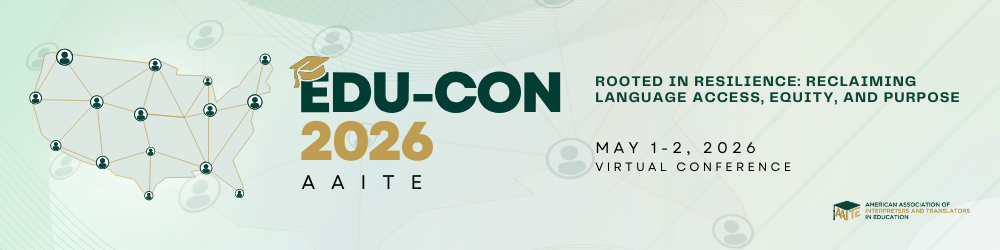
Edu-Con 2026 is set to showcase a stimulating roster of speakers hailing from various regions of the country. Attendees can look forward to engaging presentations, specialized pre-conference sessions, expert keynote speakers, and ample opportunities to explore our Sponsors & Exhibitors.
Friday, May 1, 2026 - SDS & Conference Breakout Sessions
Session Descriptions
|
| PRE-CONFERENCE SKILL DEVELOPMENT SESSIONS |
SDS 1
|
Pre-Conference Session- Translation Style Guides and Glossaries: Making Everybody's Lives Easier
Dr. Laurence Jay-Rayon Ibrahim Aibo
This training, led in English, is designed for translators and language access coordinators working in school settings. Participants with any language combination are welcome. Translation style guides reduce time spent on translation projects, increase consistency across materials, and enhance translation quality, leading to better communication with limited- English-proficient families. Based on the analysis of existing translation style guides, this workshop is an introduction to building institutional translation style guides and walks participants through the various sections of a style guide, such as translation conventions for place names, addresses, dates, times, numbers, acronyms, and glossaries of preferred terms. The workshop includes practical activities done in small groups, and participants will take home reference materials for further exploration.
|
SDS 2
|
Pre-Conference Session- Power Up Your Interpreting Skills
Carola Lehmacher
Simultaneous interpreters provide a service that is mentally taxing and requires constant upkeep. Aside from specific research and preparation, interpreters must regularly practice their simultaneous interpreting techniques to maintain and improve the quality of their renditions. Reflective practice is a common technique used to enhance any interpreting skills, however, a rubric to evaluate our own performance and a path towards improving deficiencies is essential to level up one's interpreting. This session will apply deliberate practice principles to enhancing simultaneous interpreting skills and provide a rubric and skill enhancement exercise suggestions.
|
SDS 3
|
Pre-Conference Session- The Ethics Lab: Fostering Ethical Growth in Interpreter Education
Giovanna Carriero-Contreras
Educational interpreters work within complex school systems where decisions affect student access, family engagement, and educational equity. Teaching ethics in this context requires more than reviewing a code; it demands analytical skills and professional judgment to manage real dilemmas. This session examines the AAITE National Codes of Ethics for Interpreters in Education and their practical application in schools. Participants will compare educational standards with the newly announced medical interpreter code, identify shared principles, and analyze sector-specific differences. Through structured case studies from IEPs and school meetings, participants will practice applying a clear, actionable ethical decision-making framework.
|
| MAIN CONFERENCE BREAKOUT SESSIONS |
Breakout Session 1
|
Understanding Language Access Laws in Education (Part 1)
Mireya Pérez
This session helps administrators understand the legal framework for language access in educational settings and how it applies in practice. Using examples from U.S. Department of Education Office for Civil Rights and U.S. Department of Justice cases, participants will examine findings of noncompliance, resulting resolutions, and how gaps in implementation can create risk for schools and districts.
|
Breakout Session 2
|
Reflective Practice in Action: Using Self-Evaluation to Strengthen Educational Interpreting
Lea Reyes
In an era that calls for resilience and purpose, reflective practice is essential to sustaining excellence in educational interpreting. This session introduces an Educational Interpreter Self-Evaluation Rubric designed to promote professional growth, reinforce standards, and support continuous improvement. Grounded in field-based implementation, the rubric serves as a reflective tool, not an evaluative measure, to help interpreters identify strengths, refine decision-making, and align practice with ethical and professional expectations. Participants will explore how structured self-reflection strengthens service quality, builds professional confidence, and contributes to equitable language access. Attendees will leave with practical strategies to integrate reflective tools into daily interpreting practice.
|
Breakout Session 3
|
Note-taking for Consecutive Interpreting: Enhancing Your Technique
Gabriela Espinoza Siebach
One of the most common error types in consecutive interpreting is omissions, and the culprit is usually that the idea was not fully processed or was forgotten. One technique to improve message recall and accuracy is note-taking. Note-taking equips interpreters with essential skills to capture and organize information effectively during consecutive interpretation. This hands-on introductory presentation focuses on developing concise and accurate notetaking techniques, enhancing memory retention, and honing the ability to produce high-quality interpretations. Elevate your interpreting proficiency through strategic note-taking mastery.
|
Breakout Session 4
|
"Correct” Language and Other Myths: Linguistic Prescriptivism in Interpreting and Beyond
Kelly (Grzech) Henriquez
How does what we believe about language impact how we interpret it? This workshop will examine common linguistic myths as vehicles for exploring the contrasting concepts of linguistic prescriptivism and linguistic descriptivism. We’ll explore why we might believe what we believe about language, who stands to benefit from these beliefs, and the impact of these beliefs on our interpretations. Participants will walk away with an action plan for their own professional development using what they’ve learned from the workshop.
|
Breakout Session 5
|
Language Access Plans and Policies in Practice (Part 2)
Mireya Pérez
This session examines how language access plans and policies are implemented at both the district and school level. Strong policies provide the structure for accountability, consistency, and compliance, but their impact depends on how they are carried out in practice. Participants will explore what effective systems look like, where gaps occur, and how implementation influences quality, consistency, and cost. Language access is not the responsibility of one department. It is embedded in the daily operations of a school system and requires coordination across roles to function effectively.
|
Saturday, May 2, 2026 - Main Conference Sessions
Session Descriptions
|
Breakout Session 6
|
The Power of Translation: Language Access in Children's Literature and Educational Publishing
Carolin Menéndez
As a translator and editorial consultant working in educational publishing, I collaborate on children’s books and instructional materials that reach classrooms and homes across the country. In this session, I’ll explore how translation goes beyond word-for-word rendering and becomes a form of language access that shapes literacy and family engagement. Through examples from children’s literature and educational resources, I’ll share how thoughtful translation supports multilingual learners, reflects students’ identities, and helps families connect with school materials. This session highlights the translator’s role in promoting equity, belonging, and meaningful access within diverse school communities.
|
Breakout Session 7
|
NotebookLM for Interpreters: Smarter Preparation and Custom Practice Materials
Nora Díaz
NotebookLM offers interpreters a new way to organize knowledge, prepare for assignments, and create customized practice materials. This session introduces NotebookLM through an interpreter-centered lens, focusing on educational settings. Participants will learn how to use it to ground preparation in trusted sources, generate study questions, build glossaries, and create realistic practice scenarios.
|
Breakout Session 8
|
Bridging Sight and Simultaneous for Better Performance
Agustín de la Mora
Sight and simultaneous interpretation are closely connected skills, and this session explores how mastery of one can elevate the other. Tailored for education interpreters, this session will go through techniques to build stronger processing skills, smoother delivery, and greater consistency across both modes. Participants will learn how to improve sight translation through reading for content and effective chunking, and how to enhance simultaneous interpretation using shadowing and targeted practice exercises. By understanding the relationship between these two modes, interpreters will walk away with practical strategies to increase efficiency, confidence, and overall performance in real classrooms and other educational settings.
|
Breakout Session 9
|
Lost in (Copyright) Translation
Ashley Jones-Lewis
When a client requests that a copyrighted material be translated, the translator needs to know what to do. My team and I have developed a workflow to respond to materials with a copyright to ensure we respect authors' rights and comply with copyright law. This presentation will empower you to make decisions confidently about copyrighted materials, and not shy away from translation opportunities because of their copyright status.
|
Breakout Session 10
|
Language Access 2026: What We Know, What We Can Do
Dr. Bill Rivers
This presentation will inform and engage the AAITE audience with up-to-date information on the legal status of language access in education at the national and state level, after the first year of the Trump administration. Dr. Bill Rivers, Chair of the National Coalition for Language Access, will lead participants through the current legal landscape, providing clear, actionable information regarding the civil rights requirements for language access. and will then engage participants in hands on advocacy for language access.
|
Breakout Session 11
|
Unlocking Simultaneous Interpretation: Foundational Skills and Practical Techniques
This introductory session provides a comprehensive overview of the fundamental skills and techniques necessary for effective simultaneous interpreting. Participants will gain an understanding of the cognitive processes involved, explore essential strategies for listening and processing information under pressure, and learn practical exercises to begin developing their simultaneous interpreting abilities. This session is ideal for individuals new to simultaneous interpreting or those seeking to solidify their foundational knowledge.
|
Breakout Session 12
|
Building the Airplane While Flying It: Strategic AI Integration in Educational Interpreting
Katharine Allen and Giovanna Carriero-Contreras
Your administrator declares: "This AI subscription costs $15K. You cost the district $120K. Why do we need you?" Without established regulations or standards, how do you respond with evidence, not emotion? This hands-on session reviews the SAFE AI Evaluation Toolkit to counter the false promise that AI "saves money" without sacrificing communication quality and safety. Through applied practice with three of the five critical checklists—Organizational Readiness Evaluation, Risk Factor Assessment Framework, and Vendor Assessment Checklist—you'll learn concrete skills to determine where AI can expand access in lower-risk situations while preserving human expertise for high-stakes educational encounters. |
Breakout Session 13
|
Scripting for Success: Optimized Interventions for Interpreted Encounters
Kelly (Grzech) Henriquez
The diagnostician asks you not to interpret something. The parent is speaking too quickly. A school administrator doesn't pause to allow you to interpret. You interject with important reminders but no one seems to listen. If any of this sounds familiar, this workshop is for you! We'll come together to explore the benefits of scripting our interjections and optimizing them for success. Whether you're a novice or an experienced interpreter, this session is aimed at empowering you to feel more confident and in control of interpreted encounters.
|
Breakout Session 14
|
Educational Interpreters: Building Resilience in the Age of AI
Eliane Sfeir-Markus
In an era shaped by artificial intelligence, shifting language access policies, and increasing performance expectations, educational interpreters must draw on more than technical skill to succeed. Resilience is the key in supporting interpreters as they manage cognitive load, emotional demands, role boundaries, and the pressure to adapt to rapidly evolving tools and environments. This session examines resilience through the specific lens of educational interpreting. Participants will gain practical strategies to maintain accuracy, ethical decision-making, and professional presence while navigating uncertainty and change. The session will provide actionable techniques for stress management, mental stamina, emotional regulation, and sustainable self-care.
|
Breakout Session 15
|
Make AI Your Ally: Using AI to Strengthen Language Access
Stephanie Sanyour
AI is rapidly changing the way we communicate across languages. In this session, we’ll explore how interpreters, translators, and language access professionals can make AI their ally — not their replacement. You’ll discover practical tools, strategies, and guardrails for using AI to enhance accuracy, save time, and strengthen multilingual communication.
|
Breakout Session 16
|
Before the IEP: Interpreting Autism and Developmental Evaluations Across Systems
Amairiany Amador
Educational access often begins during developmental and autism evaluations, where diagnoses and recommendations shape future school services. Interpreters working across clinical and educational settings must navigate complex terminology, cultural perceptions of disability, and emotionally charged conversations that influence IEPs, 504 plans, and school supports. Drawing from experience in both IEP meetings and clinical evaluations, this session explores terminology challenges, common family misunderstandings, and the interpreter’s role in supporting clarity across systems. Participants will gain practical strategies for preparation, terminology management, and facilitating accurate communication that supports equitable access to educational services.
|
Breakout Session 17
|
Delivering Community Interpreter Training to High School Students
Omari Jeremiah
Across the United States, there is a growing demand for trained community interpreters. At the same time, there is also a growing demand for workforce development opportunities for high school students, particularly for immigrant youth and/or English language learners. Delivering community interpreter training to multilingual high school students provides a strong and sustainable solution to both of these national demands. In this workshop, you will learn how your school/district can provide professional interpreter training to your high school students.
|
|
